I gave AI
the mouse.
I wanted help choosing players. I ended up giving a browser agent the draft room, a board, and a clock that wouldn’t wait for either of us.
About this piece
I wanted help choosing players. I ended up giving a browser agent the draft room, a board, and a clock that wouldn’t wait for either of us.
Would you wait for a quarterback?
Quarterbacks throw; receivers catch. The room is grabbing quarterbacks. I like a receiver, but I won’t pick again until 88.
- 81I took receiver Brian Thomas Jr.
- 88Justin Herbert was gone. Trevor Lawrence was still there. I took him.
Make your call, then turn over the record.
First, give it
a board.
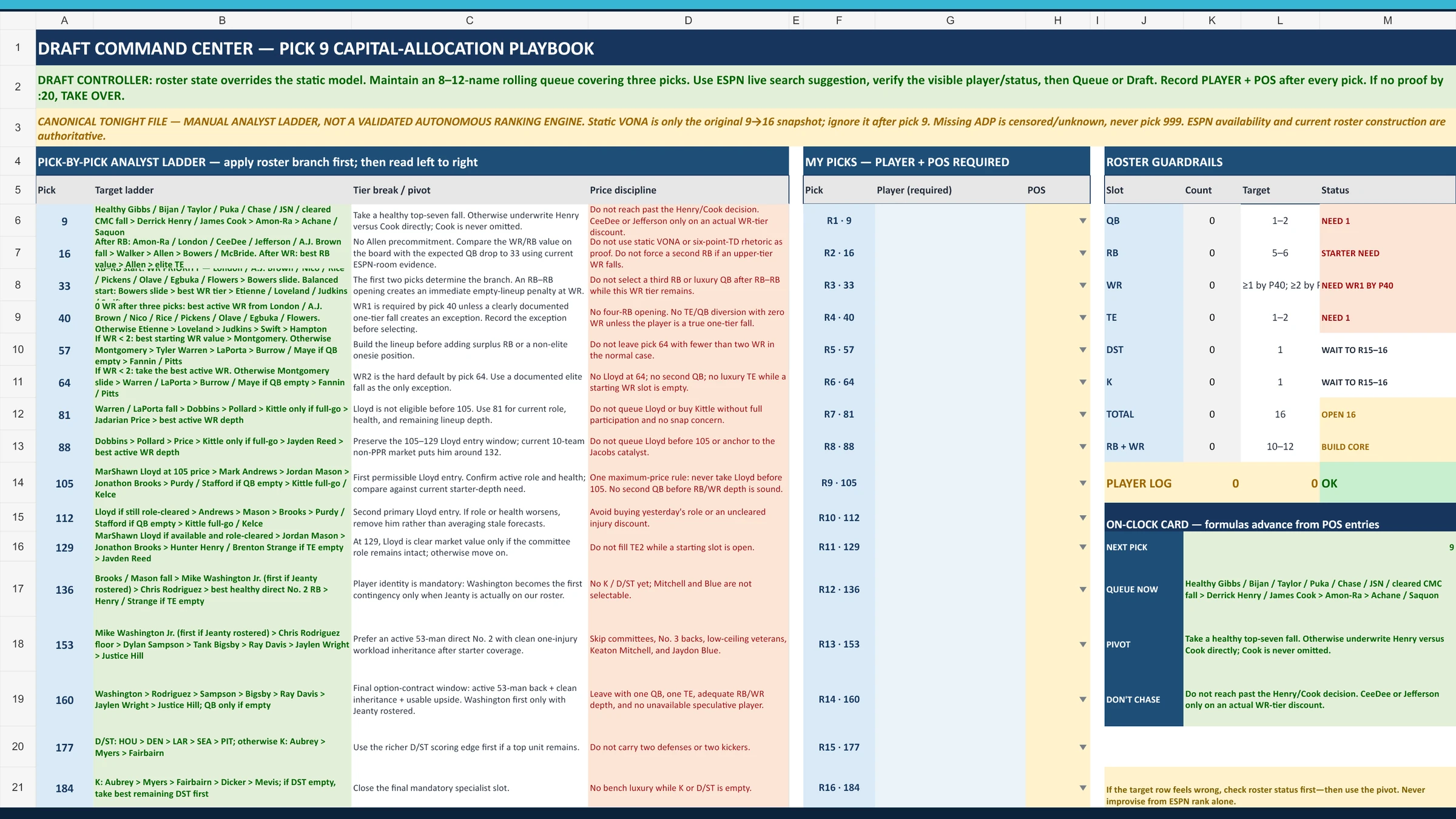
A ranking is an opinion. A draft pick is a decision with a deadline. I put player targets, roster needs, and acceptable fallbacks on a board the agent and I could both use.
Average draft position.
Very precise. Worth checking.
What made this number
look so confident?
The output looked like an estimate. One of its inputs was a placeholder.
Draft-night control: clear values at or above 500 as censored.
Try the mechanism with invented inputs
Separate arithmetic example · not a reconstruction of the historical estimate
Invented weighted blend: (120 + 140 + 999 × weight) ÷ (2 + weight). Drag toward zero to remove the code’s influence.
The simple mean includes a code that was never an estimate.
The original blend’s full inputs and weights were not recovered. This small example shows the mechanism; it does not supply a historical corrected ADP. Its contaminated mean is below 500, showing why a final-output threshold alone cannot clean every bad blend.
Check
the input.
MarShawn Lloyd’s average draft position appeared as 562.7. A missing-value code, 999, had entered the blend. On draft night, the safeguard withheld values at or above 500 and removed the misleading value-fall signal.
The full inputs and weights were not recovered. The workbench uses invented inputs to show the mechanism; it can’t supply a corrected historical pick.
See the original 562.7 artifact ↗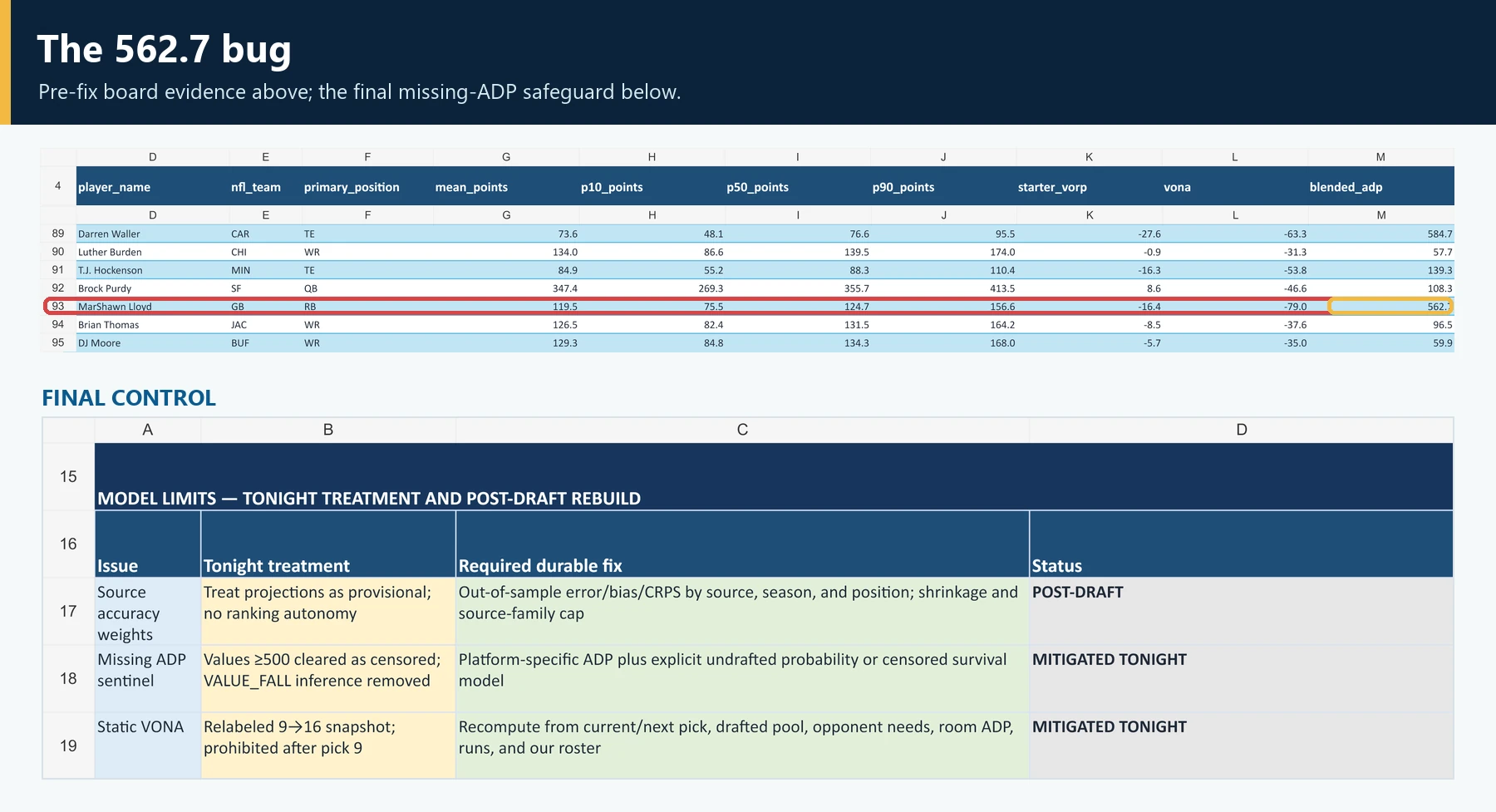
Know when
to take over.
I kept a queue of picks I could live with. It limited the damage of an unintended selection. Moving the queue near the deadline still cost me a manual intervention. Next time, I’d freeze it earlier.
See the fallback protocol ↗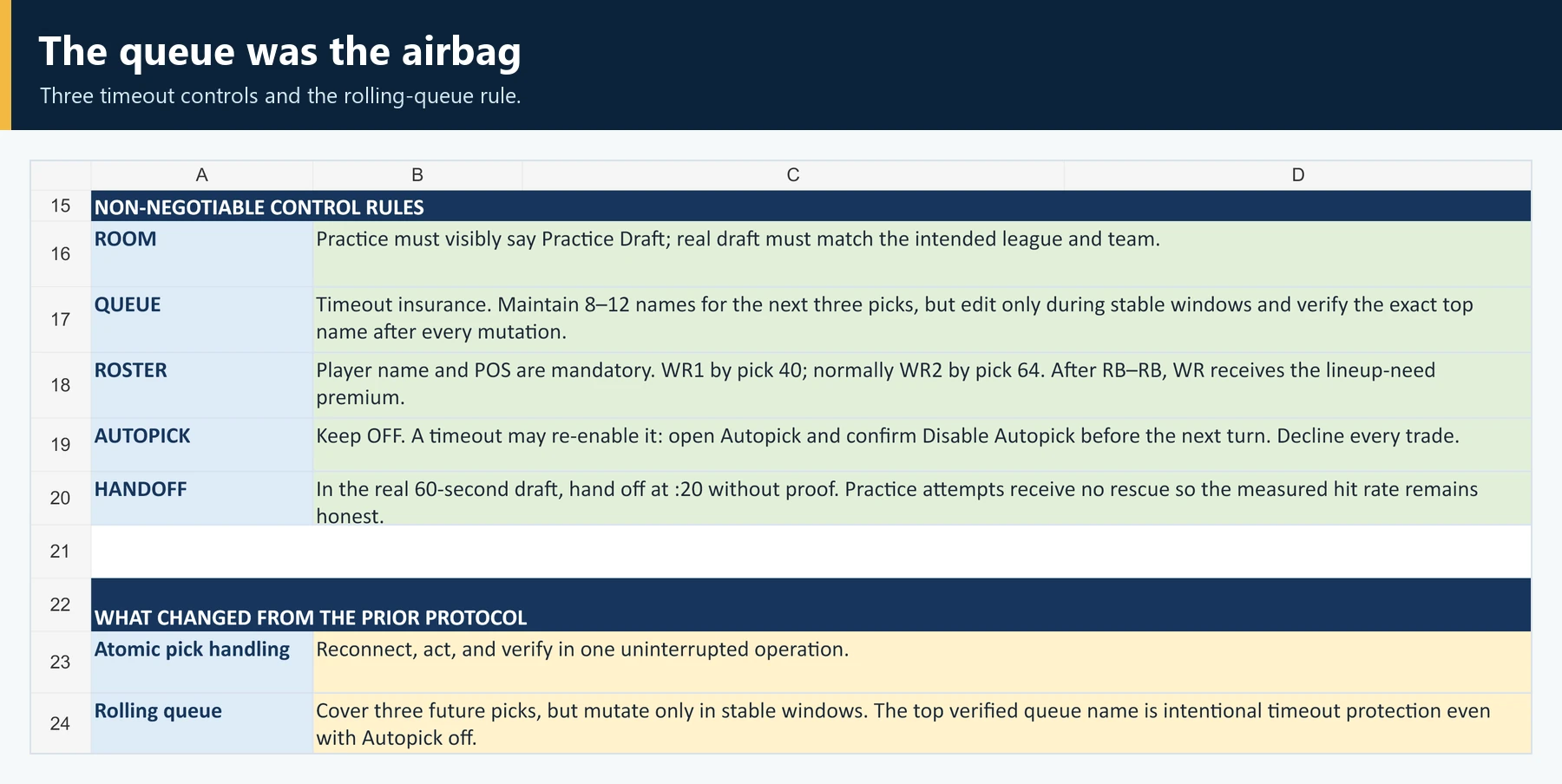
Seven
running backs.
Two starters. Five on the bench. Apparently my preference for running-back upside made it all the way through the system.
See the seven on the roster ↗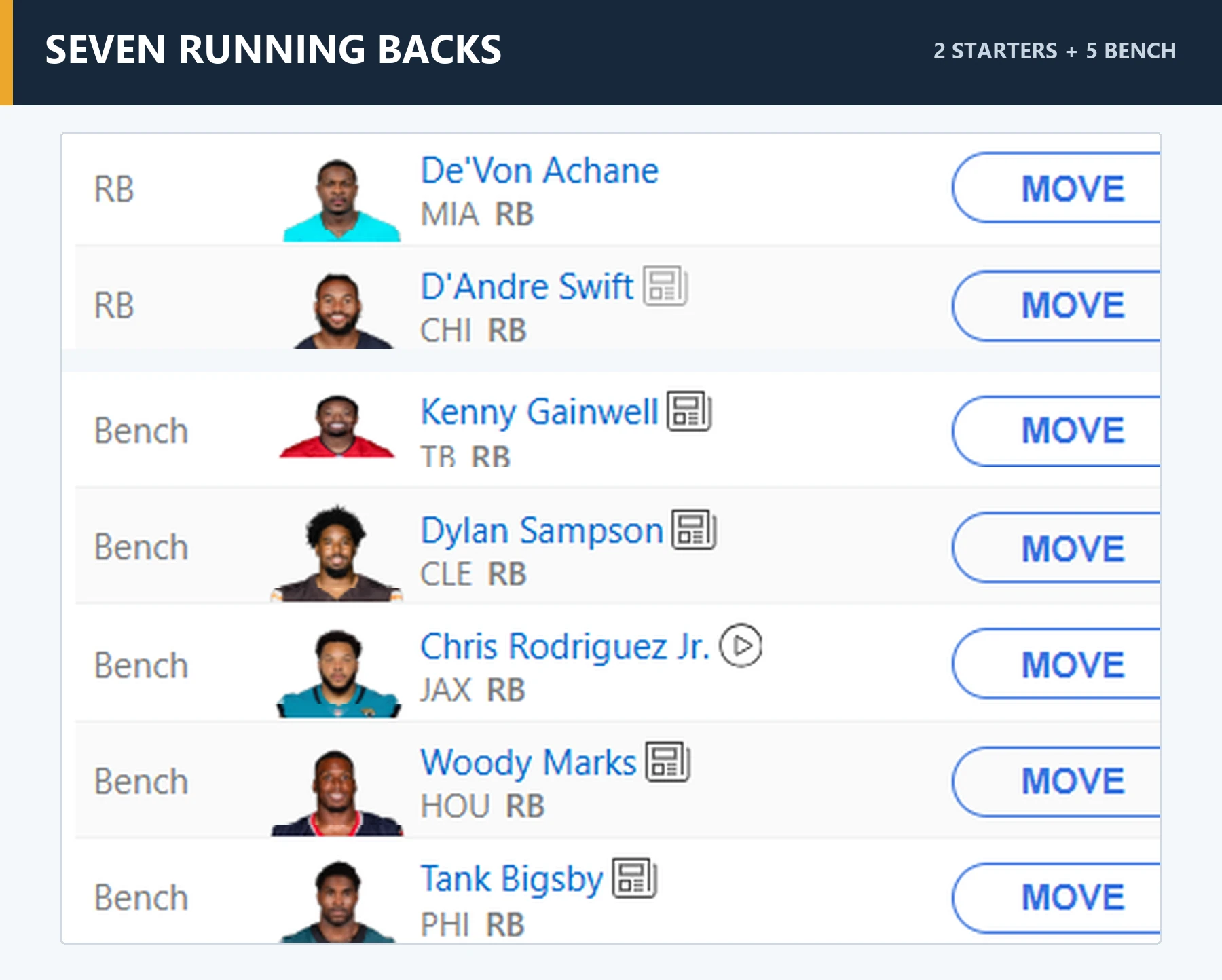
How it
helped me build.
I worked with AI on the specification and the draft board. When 562.7 appeared, I had to check the input and decide when the board should stay silent. That correction mattered as much as getting the board working.
What it
does inside.
The statistical pipeline, workbook, browser agent, and human operator each had a role. The browser agent attempted draft-room operation; the account also records mistakes and a manual intervention. Forecasts came from analytical modeling, rather than an LLM inventing player projections.